Kickless Resistance Welding Cables
Tor-Fleq Kickless Cables
Ideal for Robotic Application
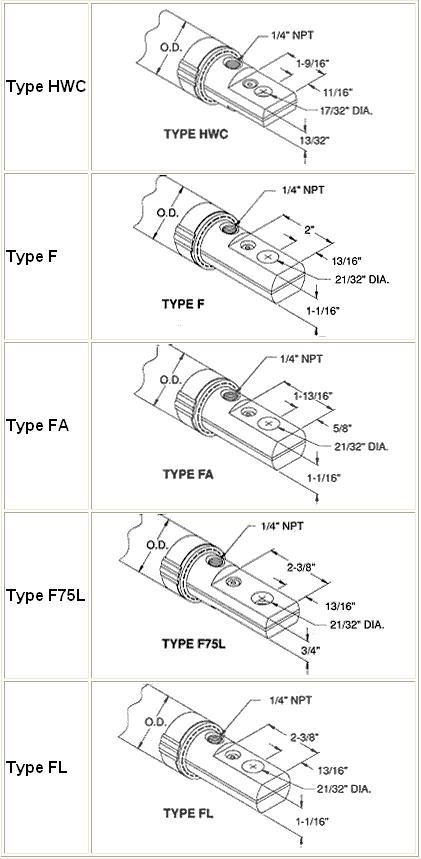
Styles of Tor-Fleq Ends
Notes:
1. Special Diameter bolt holes can be furnished upon request, as well as special terminals.
2. All water inlets are 1/4″ NPT.
Standard Mandrel Specifications
| MCM Size | Outer Diameter | Terminal Diameter |
|---|---|---|
| 300 | 1-15/16″ | 1-7/16″ |
| 400-450 | 2-3/16″ | 1-11/16″ |
| 500 | 2-3/8″ | 1-7/8″ |
| 650 | 2-1/2″ | 1-7/8″ |
HTRF Cover Hose
| MCM Size | Hose O.D. | Terminal Diameter |
|---|---|---|
| 300 | 2.08″ | 1-9/16″ |
| 400-450 | 2.33″ | 1-13/32″ |
| 500 | 2.52″ | 1-31/32″ |
| 650 | 2.64″ | 1-31/32″ |
The HTRF Cover hose was developed to combat the primary cause of water-cooled cable failure: wear through of the outer cover. Often a hose wears through due to abrasion on the welding equipment or production components.
WATTEREDGE has developed a super high abrasion compound which can outlast other materials 40 to 1 against failure due to abrasion. This compound is integrated into the HTRF cover hose, which is available for all kickless cables and also for water cooled jumpers up to 600 MCM in size.
Also available is a high abrasion thin wall sleeve, which can be mounted over the standard kickless cable hose.
Kickless Cable Jumper Sizing
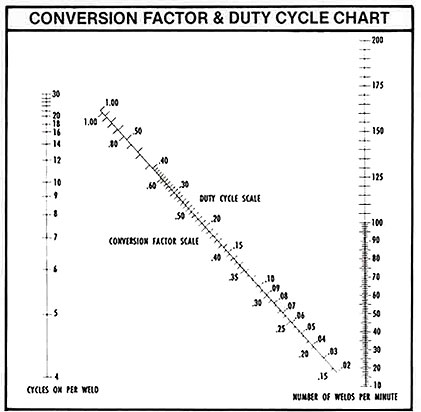
Use the following method to determine what size cable should be used for your application. First you use the Conversion Factor chart to determine your “Continuous Duty Current”; then you read the correct size cable off the second chart. An example is worked out below.
Step 1
Lay one side of a straight edge across the graph at the six cycles of current “one time” point (the left hand vertical scale of the conversion factor chart).
Example Data: 6 cycles of current “on time” per weld, 60 welds per minute, 16,000 amps per weld and 10ft cable length.
Step 2
Pivot the other end of the straight edge across to line up with the “60 welds per minute” on the far right vertical scale.
Step 3
At the intersection of your straight edge with the diagonal conversion factor scale line, you should be able to read a conversion factor of .32 off the lower 1/2 of the line.
Step 4
Multiply the required current (16,000 amps) by the conversion factor (.32) to get the “continuous duty current” of 5,080 amps.
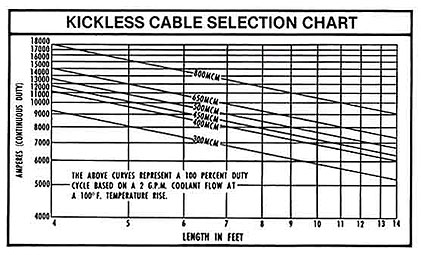
Now proceed to the Water Cooled Jumper Selection Chart to read the complete selection.
Step 5
Line up your straight edge on the 5,080 continuous duty amp mark, and find the intersection with your desired length line (from below).
Step 6
Any cable whose line is above this point may be safely used, since the load it would carry will be within its thermal capacity. In this case, a 300 MCM cable could be safely used.
| MCM | DC Resistance (Ohms per foot at 70 degree C) |
|---|---|
| * This data represents the total series resistance per foot of both conductors of the cable | |
| 300 | .000876 |
| 400 | .000620 |
| 500 | .000590 |
| 600 | .000497 |
| 625 | .000416 |
| 800 | .000326 |
Styles of Tor-Fleq Ends
To determine the voltage drop across both legs of a Dual Conductor Kickless Cable, first determine the known variables.
Example:
22,000 amps per weld, 10 foot cable length, 500 MCM circular mill
Step 1
Follow the vertical line “A” from the 22,000 ampere point on the lower horizontal axis, until it intersects the 10 ft cable curve, as indicated by the vertical right hand scale.
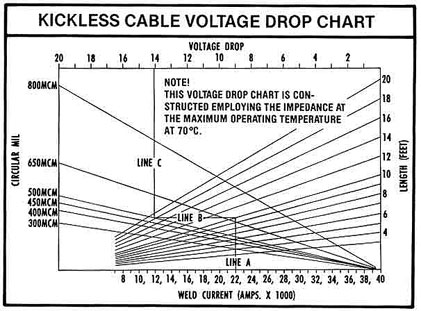
Step 2
From the point of intersection, follow the horizontal line “b” to the left until it intersects the 500 MCM cable curve, indicated by the vertical left hand scale.
Step 3
Follow the vertical line “C” from this point upward and read the voltage drop off the top axis. In this case, the voltage drop is 14.1 volts.
In specific instances, the “b” line could travel to the right from line “a”. Here is an example of such a situation. The same 22,000 amps, and 500 MCM cable are used, but change the length from 10 feet to 5 feet. Proceed up line “a” until it intersects the 5 ft line, and then a horizontal line to the right to intersect the 500 MCM curve. Then draw a line vertically until it intersects the voltage drop scale at the top, where you can read off a drop of 6.9 volts.
To read the chart correctly, always locate the known factors on the chart in the following sequence:
- Current
- Cable Length
- Cable Circular Mil
- Voltage Drop
Recommended Minimum Gallons/min
2 GPM . . . WJ (single conductor)
2-1/2 GPM . . . UT (dual conductor)
Water Flow Chart
Example:
1-8 ft 400 MCM Watteredge cable
Pressure at inlet terminal: 12 lbs.
Pressure at outlet terminal: 9 lbs.
Pressure drop: 3 lbs
To solve for the water flow, extend the 3 lb. pressure differential line upward to the intersection with the 8 ft 400 MCM curve. Then read across from the intersection to read 3.3 gallons/min of flow off the left vertical axis.
It should be pointed out that the inlet and outlet pressures should be recorded from the terminal and not the connected coolant lines. This chart was created using only one inlet and one outlet.
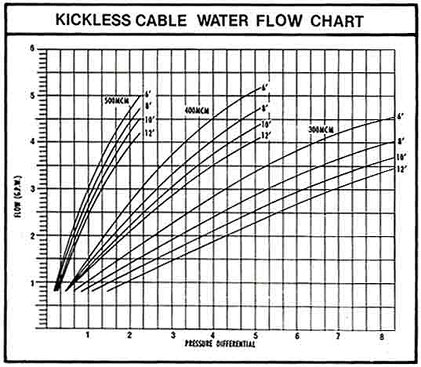
Note: These curves are only a characteristic of WATTEREDGE cables, and will not be the same for cables of other manufacture.